


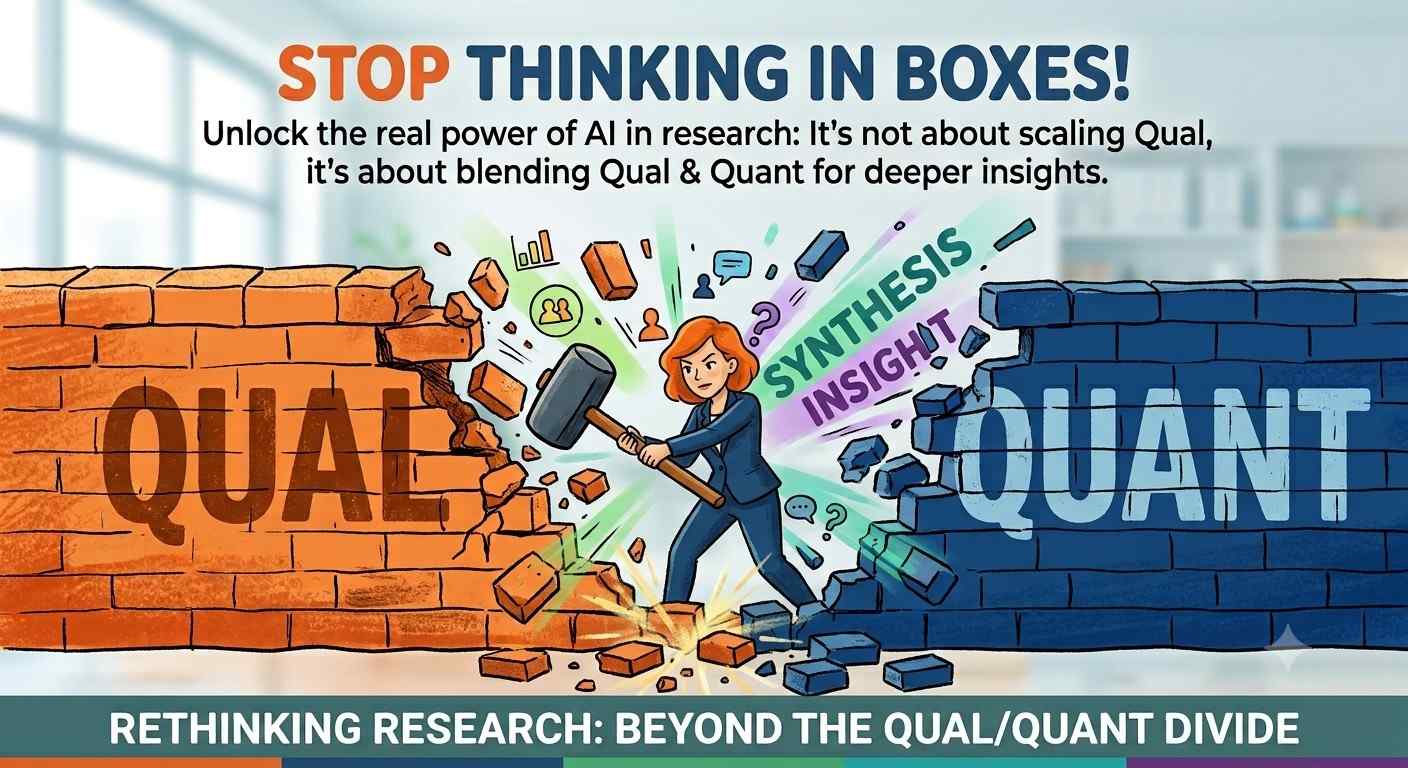
I went back through my old blog archives recently and found a post I wrote in 2016. In it, I argued that the line between qualitative and quantitative research was an artificial divide — a category researchers invented for our own convenience that didn't actually map to the questions clients were asking. At the time, I had no AI tools, no LLMs, no AI moderators. I was just dreaming.
I had no idea that AI would eventually be the thing that made the dream possible. But what I really didn't see coming was that the industry would use AI to reinforce the divide instead of dissolving it.
That's basically what "qual at scale" is. It's a category solution. It takes one half of the industry — qualitative research — and asks how we can do more of it, faster, by adding AI moderators and AI synthesizers and AI theme-extraction. The unspoken premise is that the goal of the qual side is to be more like the quant side: bigger samples, more outputs, faster turnaround.
I think we're aiming too low.
What we should actually be talking about
The interesting opportunity AI gives us isn't scaling one method to do more of what it already does. It's combining methods that used to live in separate studies into a single, smarter instrument.
Here's what I mean. Years ago, I built a study for a pharmaceutical client. They had a great drug, but doctors weren't prescribing it, and the client wanted to know why. So I designed a methodology where physicians worked through hypothetical patient profiles inside an IDI. Each patient had a specific clinical presentation — symptoms, prior medications, comorbidities, the works. I'd hand the physician the patient profile and a list of drugs and ask: which would you prescribe?
While they thought through it, they narrated their reasoning out loud. So I wasn't just capturing what they would prescribe — I was capturing why, in real time, in their own voice. That study produced one of the most fascinating looks at the psyche of American physicians I've ever seen. The crazy things I heard about how they thought about brand-name versus generic, about patient compliance, about "what the chart says" — none of that would have surfaced in a pure quant choice exercise, and none of it would have been as rigorous in a pure qual interview.
That's the kind of design I want to see more of. Not qual at scale. Not quant with a moderator bolted on. Qual and quant, deliberately combined into a single exercise that produces something neither method could on its own.
Where AI actually changes the game
What's different about doing this in 2026 versus when I designed that pharma study is that AI gives us the bandwidth to do it at scale. Smart probing on choice exercises. Real-time, moderated open-ends inside what looks like a normal quant survey. Projective techniques — guided fantasy, hot-air-balloon exercises — embedded directly into a quantitative instrument. None of these are new methodologically. What's new is that we can now run them across hundreds or thousands of respondents without burning out a team of human moderators.
Inca is one platform built around exactly this idea. It treats the qual/quant distinction as agnostic by design. You can drop a projective technique into a quant study. You can follow a MaxDiff-style trade-off with a smart-probed open-end. You can pair a choice exercise with a follow-up that asks "why" and actually keeps probing until the respondent gives you something useful.
Inca isn't the only way to do this. You could sit a focus group down in a room, hand each person an iPad with a conjoint exercise on it, let them complete it individually, and then discuss the results live as a group. You could pair a quantitative segmentation with qualitative deep-dives into the segments that surprised you, designed and analyzed as a single project rather than two. The point isn't the specific tool. The point is the thinking.
A challenge to the industry
If you take one thing from this post, let it be this: stop sorting tools, methods, and projects into a "qual box" and a "quant box."
Stop treating the two halves of our craft as sequential — first we do qual to develop hypotheses, then we do quant to test them. That linear model was a logistical compromise from an era when running both at the same time was genuinely impractical. It's not impractical anymore.
Stop asking "what's the AI version of qual?" Start asking "what's the right combination of methods to actually answer this question?"
The best research design isn't the one that fits neatly into a category. It's the one that does whatever the question requires — and increasingly, what the question requires is qual and quant happening at the same time, designed into the same instrument, analyzed together.
That's not qual at scale. That's something better.